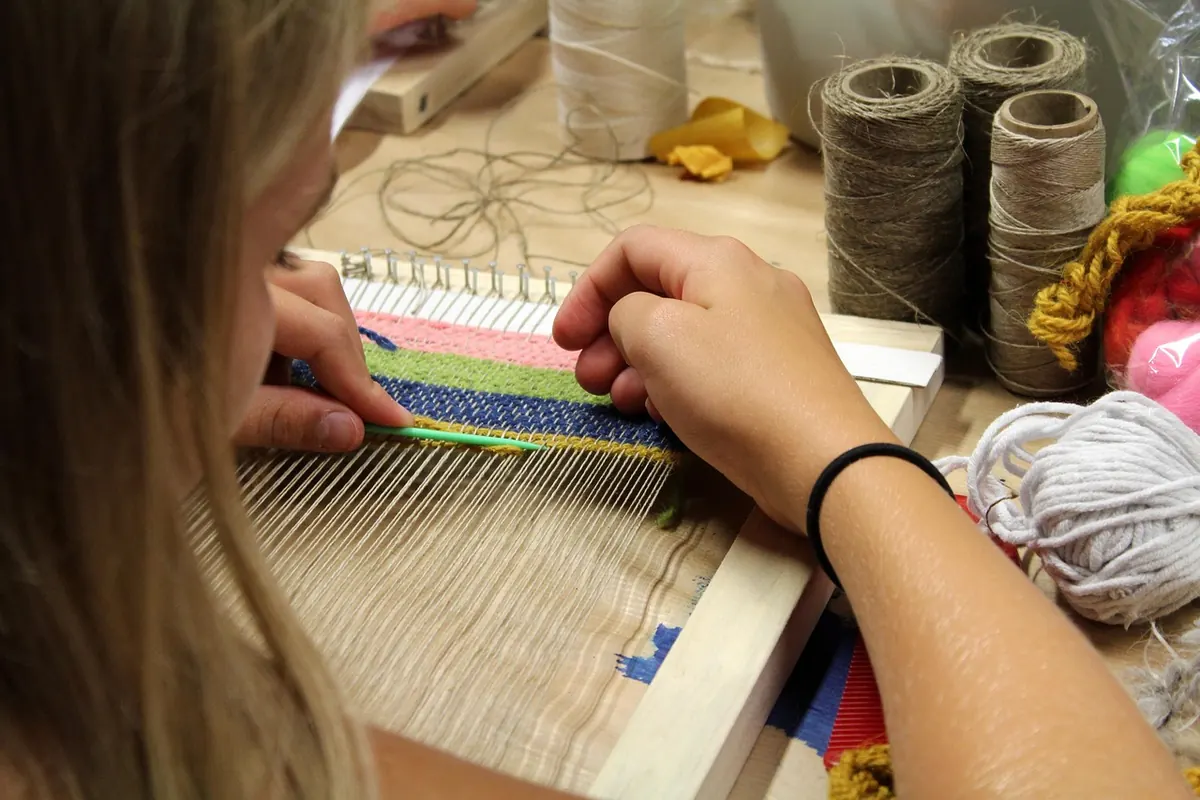
Reading a Weaving Draft: A Beginner’s Guide to Threading and Treadling Diagrams
October 29, 2026 - Weaving

Selvedges are the first thing many weavers check and the last thing they learn to control. A clean edge looks deliberate. A wavy one makes an otherwise sound piece feel unfinished. The good news is that most edge problems are not mysterious. They come from a small set of habits—how you hold the weft, how you beat, how you enter and leave the shed—and each habit can be changed without rebuilding your whole approach to weaving.
What follows are the mistakes I see most often, along with fixes that work on a floor loom, a table loom, or a rigid-heddle loom. None of them require perfect equipment. They require attention at the point where the weft turns.
Draw-in is the narrowing of the cloth as the weft pulls the warp ends together. Every woven structure draws in a little; the problem starts when you have not planned for it. If your warp is 40 cm wide in the reed and your cloth is 36 cm, draw-in is doing the talking. Fighting it after the fact usually makes the edges tighter and the middle loose.
Plan for draw-in before you thread. Add a small margin to your warp width, especially with slippery or tightly spun yarns, and check your width with a ruler every few centimetres rather than judging by eye. A temple can help hold the cloth out near the breast beam, and a floating selvedge gives the weft a reliable point to turn around. Keep your warp tension even across the width; one slack section at the edge will show up as a scalloped selvedge long before it shows in the middle.
A loose loop appears when the weft has too much slack at the turn and nothing holds it in place. The shuttle leaves the shed, the weft relaxes, and the next pick beats a small bubble into the edge. It often happens on one side only, which makes it tempting to blame the loom. More often, the weft simply was not anchored.
Leave the weft at a shallow angle as you exit the shed, hold it against the selvedge with your finger for the next pick, and catch it around the end warp if your loom allows. A floating selvedge is excellent here: it gives the weft a consistent place to wrap. Check the shuttle too. A shuttle that drags or catches can release the weft at the wrong moment.
The opposite mistake is pulling the weft tight after every pick. The edge looks crisp for a moment, then the cloth narrows and the selvedge scallops. This is often a reaction to loose loops: you overcorrect, tug the weft, and trade one edge problem for another.
Stop tugging. Lay the weft with a gentle bubble—more for lofty yarns, less for linen—and let the beater do the work of packing it in. Measure the cloth width every so often. If the edge is pulling in, adjust the angle of the weft and your hold on it before you adjust the loom.
Uneven beating shows up as ripples along the selvedge, bands of tight and loose picks, or an edge that looks bruised. It usually comes from beating in different places, with different force, or at different moments in the shed cycle. The middle of the cloth may hide it; the edge will not.
Choose one point in the cycle and beat there every time. Many weavers beat on an open shed, others after changing the shed; the important thing is consistency. Use the same amount of force for each pick, and avoid double-beating a pick you think looks loose. Advance the warp at regular intervals so the fell line stays in the same relation to the beater. If the beater itself is out of alignment, fix that before you blame your hands.
The selvedge is made at the moment the shuttle enters and leaves the shed. Dropping the shuttle in from above, pulling it out at an awkward angle, or letting it scrape the edge warps will all leave marks. You may see loops, broken ends, or a fringe of abraded yarn that looks fuzzy before the piece is even finished.
Set the shuttle into the shed rather than dropping it. Keep the entry low and smooth, catch the weft cleanly at the edge, and avoid pulling the shuttle sideways through the warp. If your shuttle has a sharp edge or a burr, smooth it or replace it. On narrow pieces, slow down: the edge is close enough that a rushed throw has nowhere to hide.
An edge can be perfectly beaten and still misbehave if the warp is poorly spaced at the sides. Too few ends at the edge, uneven denting in the reed, or a selvedge end that is much looser than its neighbours will create gaps and loops. A floating selvedge—an extra end weighted separately and not threaded through a heddle—gives the weft a reliable turning point and is worth the few minutes it takes to set up.
Check the reed plan at both edges, adjust tension end by end if needed, and make sure the edge warps are not carrying more tension than the middle. A temple can help, but it will not fix a reed that is dented unevenly.
Cloth under tension on the loom is not the same cloth that comes off. Selvedges often look slightly wavy or tight on the loom and settle after cutting off and washing. Correcting every small irregularity while the warp is still tight can make the edge worse.
Weave a sample, cut it off, and wet finish it before you decide the selvedge is a failure. If the finished sample still has loops or draw-in, adjust the cause—weft angle, beat, warp spacing—rather than pulling at the edge pick by pick.
Before you start a project, spend five minutes on the edges. It is easier than repairing them later.
Clean selvedges are not a matter of luck. They are the visible result of small, repeatable decisions at the edge. Once you know which mistake you are making, the fix is usually a change of habit rather than a change of loom.

A weaving draft is four connected diagrams, not a code. Here is how threading, tie-up, treadling and drawdown...
A practical comparison of twisted fringe, hemming and wet-finishing for handwoven scarves, judged on time,...
Copyright © 2026 Telaio Sottovoce. All Right Reserved.