Reading a Weaving Draft: A Beginner’s Guide to Threading and Treadling Diagrams
October 29, 2026 - Weaving
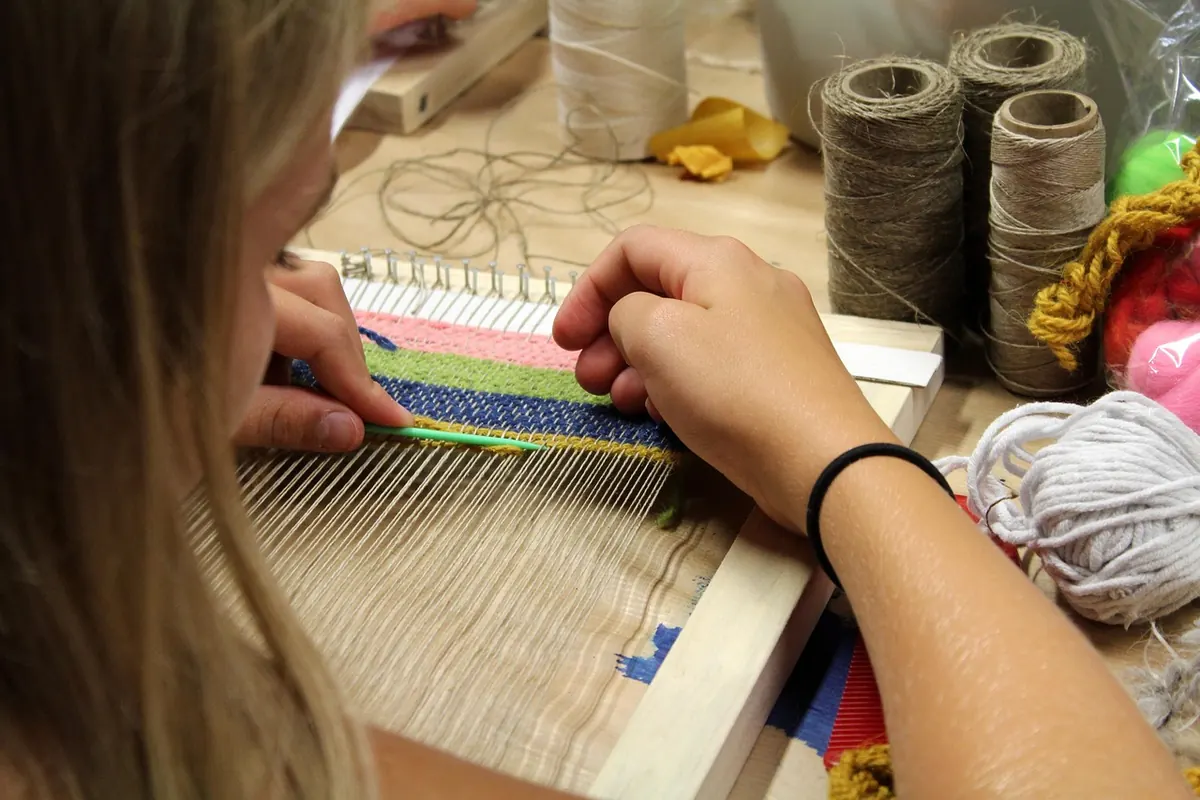
Twenty minutes is an odd length of time. Long enough to feel like a commitment, short enough to disappear into a phone. It is also roughly how long it takes to weave a few centimetres of cloth on a small loom — nowhere near enough to finish a project, which is exactly why it works.
A daily twenty-minute session does not reorganise a week. It does something smaller and more useful: it puts a fixed point in the middle of one. The loom stays out, half-warped, waiting under a cloth. You sit down, you throw the shuttle, you stop. The rest of the day arranges itself around that.
The obstacle is rarely discipline. It is setup, timing and the quiet suspicion that twenty minutes is too little to bother with. It isn't, as long as you build the habit around short sessions rather than squeezing them into the gaps between long ones.
A long session invites ambition. You plan a scarf, you warp four metres, and then a Tuesday arrives when the whole enterprise feels like a second job with worse pay. Twenty minutes invites repetition instead, and repetition is where the calm actually lives. After a fortnight your hands find the shed without being told, and the sound of the beater becomes the thing that tells your shoulders to drop.
There is also a useful discipline in a slot too short to finish anything. You cannot chase output, so you stop measuring the practice by what it produces. You weave a pass, advance the warp a notch, and get up. The cloth grows anyway.
What matters more than the length is the fixedness. Twenty minutes at roughly the same time each day — before the house wakes, or after the plates are cleared — becomes a hinge between one part of the day and the next. That hinge is the point.
Most missed sessions are not lost at the loom. They are lost in the ten minutes before it: hunting for scissors, winding a bobbin, discovering the warp has gone slack. Remove those ten minutes and the habit mostly runs itself.
Choose the loom you can leave in place. A 25 cm rigid heddle, a frame loom on a stand, an inkle loom on a side table — something that does not need to be unpacked. Cover it if you have cats or curious children, but keep the cover simple: a folded cloth, not a bag with a zip.
A generous warp on a small rigid heddle loom can carry you through weeks of short sittings: six or eight mug rugs, or a run of sample strips. Do the warping on a Sunday with the radio on, as a separate job. Never let setup eat the twenty minutes.
Two or three stick shuttles wound in different colours, a tapestry needle, small scissors, a ruler and a notebook, all in one tray that lives beside the loom. When you sit down, everything you need is already there. This single habit does more for consistency than any amount of good intentions.
Light should fall in front of you rather than over your shoulder, and the chair should put your elbows roughly level with the warp. Small adjustments, but they decide whether twenty minutes feels like rest or like strain.
Projects that suit twenty minutes are the ones you can put down mid-pass without losing your place.
If you can keep two warps going, do. A slow, dull project and a bright experimental one give you a choice on any given evening, and choice keeps the habit alive.
This shape is not a rule, but it stops the minutes leaking away at the edges.
A timer helps for the first fortnight, then usually becomes unnecessary. If a timer makes the sitting feel like a workout, use a short playlist instead.
Mark the calendar with a tick rather than a measurement. Output on any single day depends on the yarn, the sett, how tired you are and how many times a small person interrupts you; the tally of sessions does not. Twenty ticks in a month means the habit is working, even if the cloth is only a hand's width longer.
The cloth is the record, anyway. A scarf woven in fifteen-minute pieces carries the days it was made on — a slightly looser patch where you were distracted, a tidy stretch from a good week. That is not a flaw to correct. It is the difference between cloth made by a factory and cloth made by a person with a life.
You will miss days. The loom waits without judgement, and the correct response is not to make up the missing minutes in one heroic evening.
Make the restart small: five minutes, one pass, no expectation. The habit does not break because you skipped a day — it breaks because you decide the restart has to be a proper session, and then never find a proper session's worth of time.
If a whole week disappears, look at the setup before you look at your willpower. Is the loom buried behind a pile of washing? Did the warp run out three weeks ago? Fix the physical obstacle, put a fresh warp on, and start again on a Tuesday.
Choose the twenty minutes and write it down, the way you would write down an appointment. Tell whoever shares your house that this half hour is not a good time to ask you about bin day. Then sit down and weave one strip that is bad enough that you don't have to be proud of it: uneven edges, a visible mistake, weft ends left dangling for now. The point is to prove to yourself that twenty minutes is enough to make something, and that stopping on time is part of the practice rather than a failure of it.
Do that five times in a week and the week has a different shape. Not slower in any measurable way — the emails still arrive, the commute is the same length — but with a quiet quarter of an hour in it that belongs to you and to a piece of cloth that is slowly getting longer.
A final sensible note: a calming habit is a good companion, not a treatment. If restlessness, sleeplessness or low mood persists, weaving will not fix it, and it is worth speaking to a medical professional rather than trying to out-weave it.
Photo: _Alicja_ / Pixabay

A weaving draft is four connected diagrams, not a code. Here is how threading, tie-up, treadling and drawdown...
A practical comparison of twisted fringe, hemming and wet-finishing for handwoven scarves, judged on time,...
Copyright © 2026 Telaio Sottovoce. All Right Reserved.